
Tangerang Selatan, 22 June 2026 – Kolej Dato’ Onn Jaafar, Universiti Teknologi Malaysia, continues
to strengthen its role as a living lab for applied research, innovation, and
international collaboration through the dissemination programme titled Dissemination
of Webcam Visible Spectrometer (WeViSpec)-Honey Adulteration Detection at Kolej
Dato’ Onn Jaafar Living Lab. The activity was held at the Main Meeting
Room, Achmad Bakrie Building, Institut Teknologi Indonesia, Tangerang Selatan,
Indonesia, on Monday, 22 June 2026, from 9.00 a.m. to 12.00 p.m.
The programme was led by Prof. Dr. Agus Setyo Budi, M.Sc. from Universitas Negeri Jakarta as the Head of the Community Service Team. The activity also highlighted the important role of Dr. Mohd Amri bin Md Yunus, Chairman of Kolej Dato’ Onn Jaafar, Universiti Teknologi Malaysia, in strengthening KDOJ as a collaborative living lab platform that connects academic expertise, technological innovation, and community-oriented solutions.
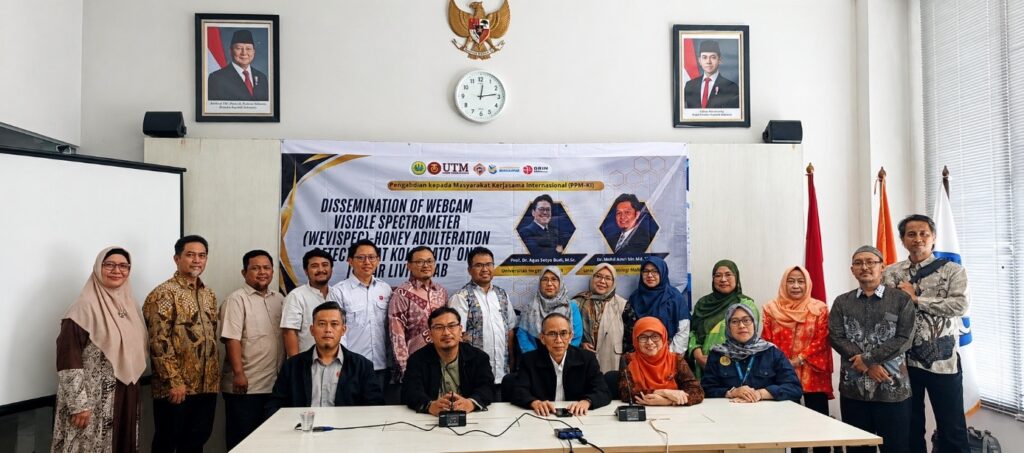
Participants of the WeViSpec dissemination and international research networking forum involving UNJ, UTM, ITI, and BRIN at Institut Teknologi Indonesia, Tangerang Selatan, Indonesia.
The forum featured three invited speakers. Dr. Mohd Amri Bin Md Yunus from the Faculty of Electrical Engineering, Universiti Teknologi Malaysia, presented insights on future-ready skills, design thinking, and artificial intelligence applications, Hendri Maja Saputra, Ph.D. from the Robotics and System Intelligence Research Group, BRIN, shared research perspectives on intelligent mechatronics, robotics, and future collaboration pathways. Ir. Saharudin, ST, MEngSc, IPM discussed Wireless Sensor Networks and their applications in environmental monitoring, smart systems, agriculture, industry, and Internet of Things-based platforms.
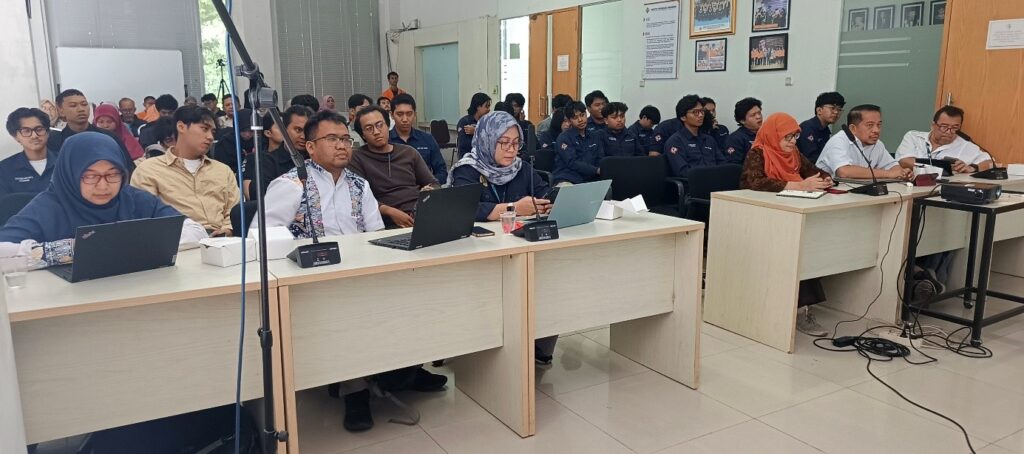
The event was attended by students and lecturers from Institut Teknologi Indonesia, students and lecturers from Universitas Ibnu Chaldun Bogor, and researchers from BRIN. The Rector of Institut Teknologi Indonesia, Prof. Dr. Ir. Syopiansyah Jaya Putra, M.Sis., IPU, ASEAN Eng., also attended the event. Other invited academic leaders included Dr. Ir. Tris Dewi Indraswati, M.T., Coordinator of the Electrical Engineering Study Programme at Institut Teknologi Indonesia, and Dwi Susanti, M.Pd., Coordinator of the Physics Education Study Programme, Faculty of Mathematics and Natural Sciences, Universitas Negeri Jakarta.
This activity is part of the preparation and dissemination series before the main WeViSpec programme at Kolej Dato’ Onn Jaafar Living Lab, Universiti Teknologi Malaysia, which is planned to be held at the end of July 2026. Through this series, KDOJ Living Lab is positioned not only as a venue for technology demonstration, but also as an open innovation ecosystem for co-creation, prototype testing, applied learning, research networking, and community-based innovation.
WeViSpec is a visible light spectrometer based on a webcam and low-cost optical components. The device is designed to support early screening of honey adulteration through spectroscopy and data analysis. In the context of KDOJ Living Lab, WeViSpec has strong potential to become a practical learning and research tool for food authenticity studies, science education, instrumentation training, and technology transfer activities.
The development of WeViSpec is highly relevant to the living lab approach because the device requires direct interaction between developers, users, researchers, students, and community partners. Through KDOJ Living Lab, the prototype can be tested in a real-world context, evaluated by users, improved through feedback, and transformed into a more sustainable learning and research facility.
Dr. Mohd Amri Bin Md Yunus emphasised the importance of design thinking and artificial intelligence in developing technologies that respond to real user needs. This perspective is essential for the future development of WeViSpec, especially in improving device usability, data interpretation, and decision-support features. By applying design thinking, the tool can be refined to become more user-friendly for students, researchers, educators, and community users. By integrating artificial intelligence, the device can support more accurate classification and prediction of honey adulteration.
The presentation by Hendri Maja Saputra, Ph.D. provided a wider perspective on the future development of WeViSpec through intelligent mechatronics and robotics. This opens opportunities to improve the mechanical design, sensing system, calibration process, automation, and data acquisition workflow of the device. These elements are important if WeViSpec is to be developed from a laboratory prototype into a more robust, portable, and replicable instrument.
Meanwhile, the presentation on Wireless Sensor Networks by Ir. Saharudin, ST, MEngSc, IPM gave another direction for the future expansion of WeViSpec. The device could be developed as part of a connected sensing system, where measurement data can be transmitted, monitored, and analysed in real time. This direction is relevant for the development of KDOJ Living Lab as a smart and sustainable innovation space that integrates sensors, Internet of Things, edge computing, and applied data analytics.
Through this programme, KDOJ Living Lab has the opportunity to expand its role as a centre for applied learning and international research collaboration. The WeViSpec project can support student involvement in prototype assembly, calibration, sample measurement, data processing, module development, and scientific publication. It can also strengthen the collaboration between UTM, Universitas Negeri Jakarta, Institut Teknologi Indonesia, and BRIN in the fields of instrumentation, artificial intelligence, sensor technology, science education, and community-based research.
The activity also supports the long-term development of KDOJ Living Lab as a platform for sustainable campus innovation. The living lab can facilitate repeated use of the WeViSpec kit, development of operational procedures, creation of datasets, training of users, and continuous improvement of the prototype. This approach allows KDOJ to become an active site for research implementation rather than only a location for one-time activities.
In the closing session, the Rector of Institut Teknologi Indonesia, Prof. Dr. Ir. Syopiansyah Jaya Putra, M.Sis., IPU, ASEAN Eng., expressed his hope that this activity would open wider opportunities for concrete collaboration among UNJ, UTM, ITI, and BRIN. The collaboration is expected to continue through joint research, academic mobility, technology development, and future international conference initiatives.
This international dissemination programme marks an important step in strengthening Kolej Dato’ Onn Jaafar Living Lab as a collaborative innovation platform. Under the leadership of Dr. Mohd Amri bin Md Yunus as Chairman of KDOJ, the living lab is expected to grow as a strategic space for applied research, student engagement, community empowerment, and international partnership.